The Verisk UX Guild: Building Influence Without Authority
Note: some details below are described generically to protect confidential business information. The process, my role, and the outcomes are accurate.
The problem
Design teams at Verisk weren't talking to each other. I was vaguely aware other teams existed somewhere in the company, but we'd never collaborated, and I had no real sense of what they worked on. The result was predictable: designers felt isolated, work got duplicated across business units, and there was no consistency in how design decisions got made company-wide.
That is all a problem, but I didn’t think it was my problem. The thing that actually pushed me to act was Figma. Verisk had 11 separate Figma accounts, each run independently — its own billing, its own user management, its own everything — and I managed the largest account. Ask the wrong person how to get access, and you'd end up set up in the wrong account entirely. It was a small, dumb, constant tax on everyone's time, and it was the clearest possible symptom of a much bigger problem: nobody owned "how design works" across the company.
The constraint that shaped everything
The obvious fix would be a top-down standards mandate. I couldn't do that. I was a UX Manager inside a single business unit — Property Estimating Solutions — not part of a corporate design function. I had direct authority over three people, and strong influence with maybe 7 to 10 more. Everyone else at the company doing UX and product design work had no idea who I was.
Getting a corporate executive to sponsor a mandate across every business unit felt like a long, uncertain path, and not one I was confident would actually work even if I took it. So I didn't try to build authority. I built something that by it’s nature is voluntary, cross-functional, and opt-in: a guild.
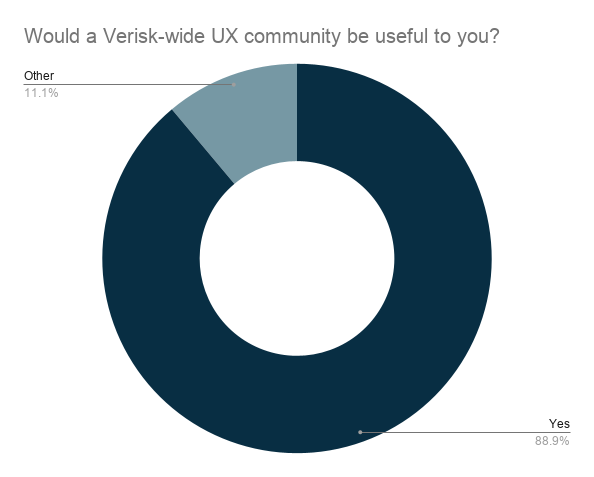
Before committing, I tested the idea. I built a short survey and sent it to nine UX leaders across the company. I did have to search the database to identify 5 of them. I asked two questions: Is this needed? and Would you attend? Everyone said yes to both. That was enough to move forward.
Finding people & getting started
There was no company list of "everyone who does user experience at Verisk." I built one by searching the company directory for anyone with "UX" in their title, then cross-checked LinkedIn for Verisk employees with UX-adjacent titles I might have missed. That first pass probably reached about 60% of who's in the guild today — the rest have been added over time by guild members as we learn more about design across the company. The community is not exclusively UX designers either; we welcome product managers, program managers, engineers, and anyone who has an interest in improving the user experience.
I launched wide immediately rather than starting small and growing — a Teams channel, everyone I'd found invited at once, quarterly one-hour meetings. Channel activity has stayed pretty quiet, which I've stopped worrying about; what I actually care about is that meeting attendance has stayed high.
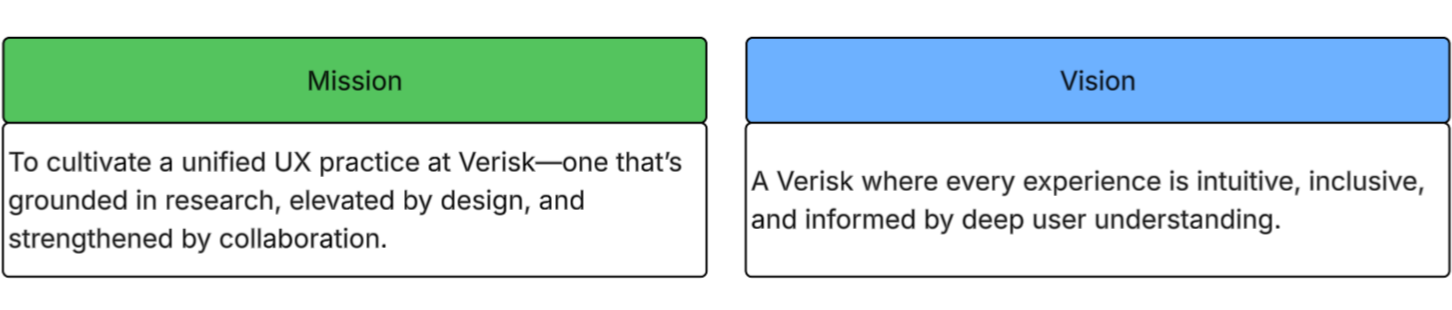
The first session was deliberately open-ended: a virtual whiteboarding workshop asking people what pain points they were experiencing, what their products did, who their users were, and what they wanted the guild to accomplish. After the meeting ended, I took what the group had agreed we wanted to accomplish and drafted 3 options for both our Mission and Vision statements. In our second session, we voted on which the community wanted to use. They are at the top of every agenda in every meeting we have.
I put all the topics people added during the first session in a survey and asked people to rank the topics by their personal interest. From there, I created a schedule of topics for our sessions and asked people to sign up to lead the discussion for each topic. Each person has a different definition of what “lead the discussion” means. Sometimes we get presentations, sometimes we get whiteboarding ideation sessions, and sometimes we get interactive quizzes. It all works as long as we are connecting and improving our craft.
The moment I thought it might get shut down
During our third session, a product manager lead our discussion on building empathy with users. He had done a lot of preparation, building out his slides in Figma Slides, and asking people to watch videos before the session about Temple Grandin. The point he was trying to make is that we needed to shift our perspective to build empathy, but during the presentation he played an emotionally raw scene from the 2010 film staring Claire Danes. The emotions involved were a little too poignant in the scene. Additionally, it was evident from his slides that he was not trained as a designer.
Verisk's Branding team had just discovered the guild existed and joined our session for the first time. The AVP of Brand messaged me directly, asking why the presenter hadn't used the standard template. My heart dropped into my stomach.
The product manager was sharing good information (albeit in an off-brand way) in an internal forum. I explained to the AVP of Brand that I don't dictate what tools people use for their own portion of a guild session, but I understood the concern. At the time, there simply wasn't a Figma Slides template that matched Verisk's brand for anyone to use even if they'd wanted to.
So I built one, and published it a few weeks later.
It's a small thing, but it's the guild in miniature: I didn't have the authority to tell anyone what tool to present in, and I didn't try to get it. I also don’t believe that it is worth the effort to force someone to do something they don’t want to do. Instead, I provided options to address the actual reason the problem kept happening.
What worked, and what didn't
The guild has run for almost three years now, grown well past its original 9 leaders I surveyed to 50+ members, and become a real cross-business-unit forum — something that didn't exist at all before. It's also become a channel for things beyond its original scope: I've used it to train designers company-wide on AI adoption, and it's connected people across teams who'd otherwise have never known the others existed. We’ve created indexes of the design and analytics tools we’re using so we know what tools are licensed by the business without having to reach out to procurement. We’ve partnered with the Brand team to align our technology and design guidelines so our products feel like they are part of the same suite.
But, it didn’t fix the 11-Figma-accounts problem that motivated me to start it. I was hoping the guild would build enough cross-business-unit momentum to make the case for consolidating onto Figma's Enterprise tier, which solves most of the administrative mess automatically. My own business unit's leadership looked at the cost and decided they'd rather keep paying for my time to manage it manually — I tracked it, and my labor ran about $10,000 a year — than pay for the tooling that would remove the need (a $12,000 increase). I never found enough support from other business units to change that calculus.
I set out to fix a tooling problem and didn't. What I got instead was a community, a training channel, and a company-wide network that's outlasted the original motivation by years. You win some, you lose some.
This is the project I point to when someone asks how I lead without a mandate: find out who actually has the same problem, prove it's real before asking anyone to commit to anything, and remove the thing that's actually in the way instead of the thing you have permission to touch.